
We regularly meet businesses applying a media buying playbook borrowed from a completely different business model — a lead gen company running e-commerce-style dynamic product ads with nothing to dynamically show, or a D2C brand chasing “lead quality” metrics that don’t map to a single-purchase decision. The platforms are the same. The underlying strategy shouldn’t be.
Tags
The Core Difference: What Happens After the Click
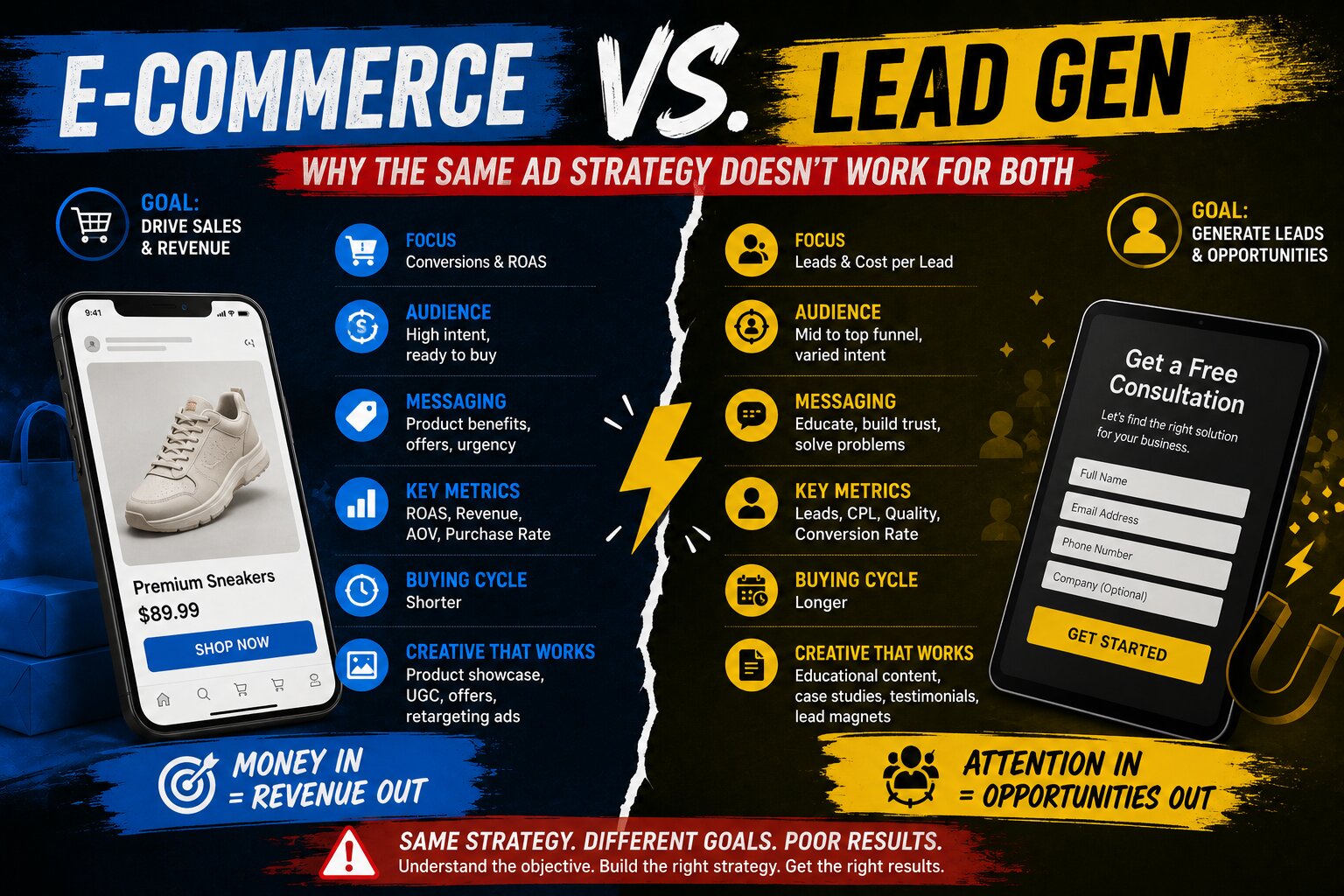
E-commerce ads sell a transaction. Lead gen ads sell a conversation. That single difference changes almost everything downstream.
- E-commerce: the ad’s job ends at checkout. Success is measurable in the platform almost immediately.
- Lead gen: the ad’s job ends at a form-fill or call booking - the actual “sale” happens later, often through a human sales process the ad platform can’t see at all.
This is why lead gen accounts optimizing purely for “cheapest cost per lead” often end up with a pipeline full of unqualified leads that look great on the ads dashboard and terrible on the sales team’s call sheet.
Where the Two Strategies Diverge
1. Optimization Event
- E-commerce optimizes toward Purchase, with clear revenue value attached to every conversion.
- Lead gen should optimize toward Qualified Lead, not raw form submissions - which usually means feeding CRM data (closed-won, disqualified) back into the ad platform so it learns to find people who actually convert, not just people who fill out forms.
2. Creative Approach
- E-commerce creative sells the product - UGC, product-in-use, social proof, urgency (limited stock, sale ending).
- Lead gen creative sells the problem being solved - the click is a much bigger commitment (“give this company my phone number”) than an impulse product click, so trust and specificity matter more than urgency.
3. Funnel Length and Attribution
- E-commerce funnels are short; attribution windows of 1–7 days usually capture most of the buying decision.
- Lead gen funnels can run weeks or months from first click to closed deal, meaning short attribution windows systematically undercount what’s actually working - a real driver of the “Ads Manager and CRM don’t agree” problem.
4. What “Scaling” Actually Means
- E-commerce scaling is largely a budget and audience question - more spend, broader targeting, more creative variants, once ROAS is proven.
- Lead gen scaling is gated by sales capacity. Doubling lead volume is meaningless - and often damaging to close rates - if the sales team can’t follow up within the response window that actually converts.
The Mistake That Happens Most Often
Applying e-commerce logic to lead gen: chasing the lowest cost-per-lead as the primary KPI. It’s the metric the platform makes easiest to optimize toward, and it’s frequently the wrong one - cheap leads are often cheap because they’re less qualified, not because the campaign is more efficient.
The reverse mistake also happens: e-commerce brands overbuilding “nurture” sequences and multi-touch attribution models better suited to a long B2B sales cycle, when most of their customers decide in a single session.
What We Actually Do Differently by Model
- For e-commerce: tight feedback loop between product margin and ROAS targets, aggressive creative testing cadence, short attribution windows that match the actual buying behavior.
- For lead gen: CRM-integrated optimization toward lead quality (not volume), sales-and-marketing alignment on what “qualified” means before the campaign launches, and attribution windows long enough to reflect the real sales cycle.
The Uncomfortable Truth
A media buyer who’s only ever run e-commerce accounts will instinctively optimize a lead gen account toward the wrong signal, and vice versa - not out of incompetence, but because the muscle memory from one model actively misleads in the other. If your agency runs both types of accounts the same way, that’s worth asking about.
Not sure which option makes the most financial sense for your business? Book a free strategy call and we'll review your numbers honestly—even if the conclusion is that you don't need an agency yet.