
Ask ten agencies what ROAS you should expect, and you’ll get ten different numbers — most of them pulled from a generic “industry benchmark” that has nothing to do with your margins, your average order value, or your actual funnel. A target that isn’t grounded in your numbers isn’t a target. It’s a guess with a decimal point.
Tags
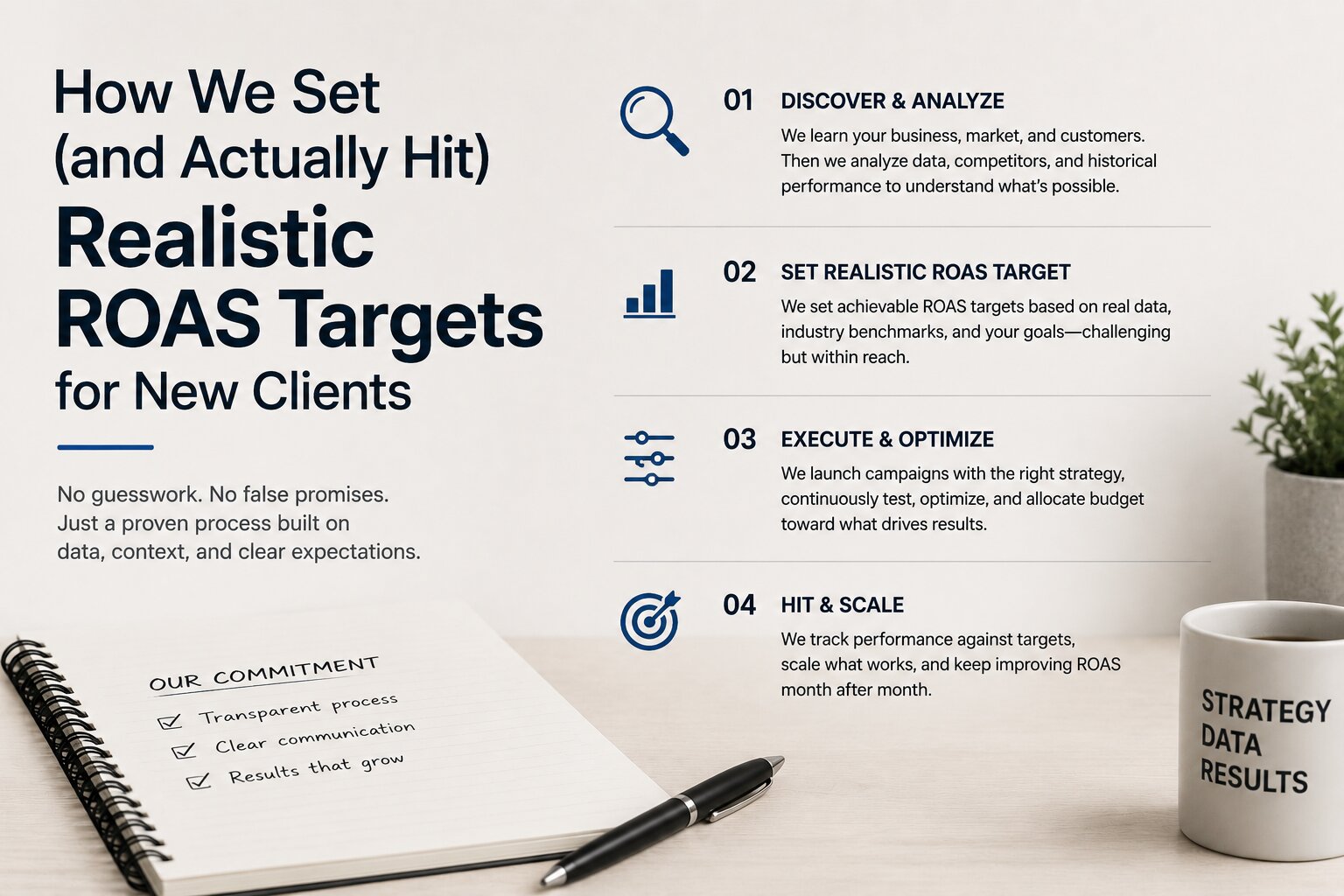
Here's the actual process we run before agreeing to any number.
Step 1: Reverse-Engineer From Margin, Not From Benchmarks
The starting question isn’t “what’s a good ROAS in this industry.” It’s: what ROAS does this business need to be profitable?
That means working backward from:
- Product or service margin (after cost of goods, not revenue).
- Fixed costs that need to be covered by ad-driven revenue.
- Any discounting, shipping subsidies, or payment processing fees baked into the actual sale price.
A business with 70% margins can be comfortably profitable at 2x ROAS. A business with 20% margins might need 5x just to break even. Using an “industry average” for either one sets a target that’s either meaninglessly easy or impossible from day one.
Step 2: Separate the Break-Even Target From the Growth Target
We set two numbers, not one:
- Break-even ROAS - the floor. Below this, we’re actively losing money and need to pause or fix something immediately.
- Growth ROAS - the target we’re actually optimizing toward, with room above break-even for reinvestment and profit.
This distinction matters because it changes how a “disappointing” month gets read. A campaign running above break-even but below the growth target isn’t a failure - it’s a normal part of scaling. Conflating the two is how clients panic over numbers that are actually fine.
Step 3: Account for the Learning Period Honestly
We don’t set the growth target as the expectation for month one. Early weeks are spent gathering data, and ROAS is typically more volatile and lower than the stabilized number. We tell clients this upfront, with a rough timeline (usually 2–4 weeks depending on budget and audience size), so a slow first two weeks isn’t mistaken for a broken strategy.
Step 4: Build in a Review Trigger, Not Just a Target
A single target number invites a binary “hit it or didn’t” judgment, which isn’t useful mid-campaign. Instead, we agree on trigger points in advance:
- If ROAS is below break-even for more than 10 days after the learning phase, we pause and diagnose before spending further.
- If ROAS is meeting the growth target consistently for 2+ weeks, that’s the signal to scale budget, not just celebrate the number.
What Happens When We Miss the Target
We don’t hide behind “the algorithm” when a target isn’t hit. The honest breakdown is usually one of three things:
- The target was set on outdated margin data - and needs to be recalculated, not chased.
- Creative or offer fatigue is suppressing performance, independent of targeting.
- The market genuinely shifted - CPMs rose across the platform, competitors entered, seasonality hit - and the target needs a documented revision, not silent adjustment.
The Uncomfortable Truth
Any agency can promise you an impressive ROAS number in a first call. The number that matters is the one that was actually calculated from your margins, has a break-even floor underneath it, and comes with an honest account of when and why it might move. If your current target didn’t come from that kind of process, it’s worth asking where it came from.
Not sure which option makes the most financial sense for your business? Book a free strategy call and we'll review your numbers honestly—even if the conclusion is that you don't need an agency yet.