
The most common way we see businesses damage a working campaign isn’t bad targeting or weak creative — it’s scaling too fast, on the assumption that a campaign doing well at RM10,000/month will do proportionally well at RM30,000/month. It rarely does, and the reason is predictable once you understand what actually breaks.
Tags
Why Scaling Isn’t Linear
A campaign that’s profitable at a given budget has usually found its most efficient, highest-intent slice of the audience. Increasing budget forces the algorithm to reach further into that audience — people slightly less likely to convert, at a slightly higher cost. Scale too fast, and you’re not doing “more of what’s working.” You’re diluting it faster than the algorithm can adjust.
What Breaks First
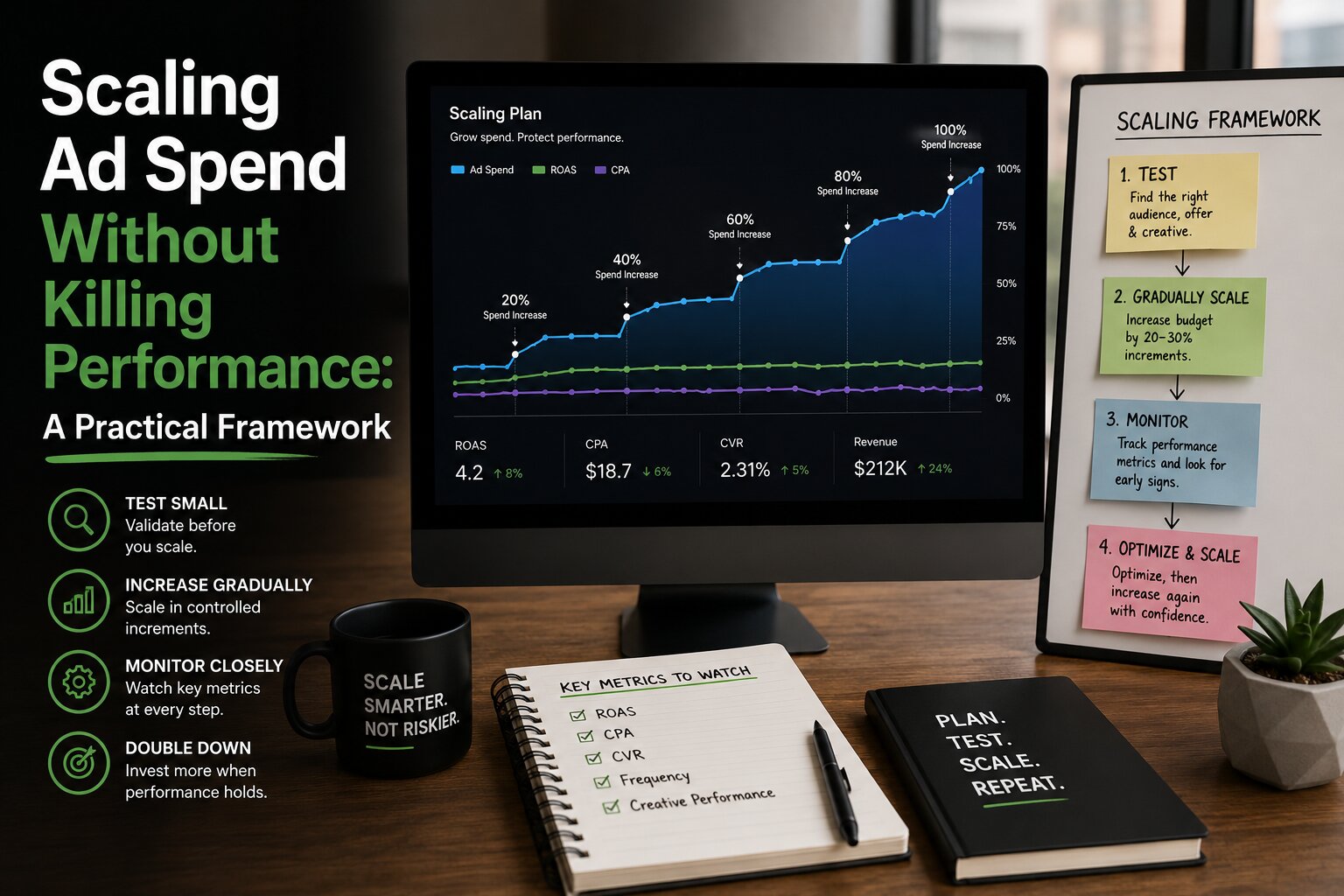
As a general guide, budget increases of roughly 20% every 3-5 days keep the algorithm’s learning stable while still moving meaningfully. Jumping 2-3x in a single day almost always triggers a rocky reset. Exceptions worth knowing: - If you’re expanding into a genuinely new audience segment or platform alongside the increase, a larger jump can make sense — you’re not diluting the same pool, you’re adding a new one. - If a campaign has been stable and profitable for several weeks with consistent creative refresh, it can tolerate faster increases than a campaign still in its first month. Vertical scaling — just raising budget on the same campaign — is the first lever most people reach for, and the one that breaks fastest. Horizontal scaling is usually more durable: Most sustainable scaling is a mix of both — moderate vertical increases on proven campaigns, combined with horizontal expansion to avoid over-saturating a single audience. The Signal That Tells You It’s Time to Slow Down At that point, the right move is usually to pause the increase and let the campaign restabilize — not push through, and not panic-cut the budget back to zero, which resets learning all over again. What We Actually Do When Scaling a Client Account Fast scaling looks impressive in a case study screenshot and is one of the most common ways a genuinely good campaign gets ruined. Sustainable growth in an ad account looks less dramatic than people expect — steady increases, consistent creative refresh, and a willingness to slow down when the data says so, even when the pressure is to spend faster.
Not sure which option makes the most financial sense for your business? Book a free strategy call and we'll review your numbers honestly—even if the conclusion is that you don't need an agency yet.
The 20% Rule (And When to Break It)
Horizontal vs. Vertical Scaling
The Uncomfortable Truth