
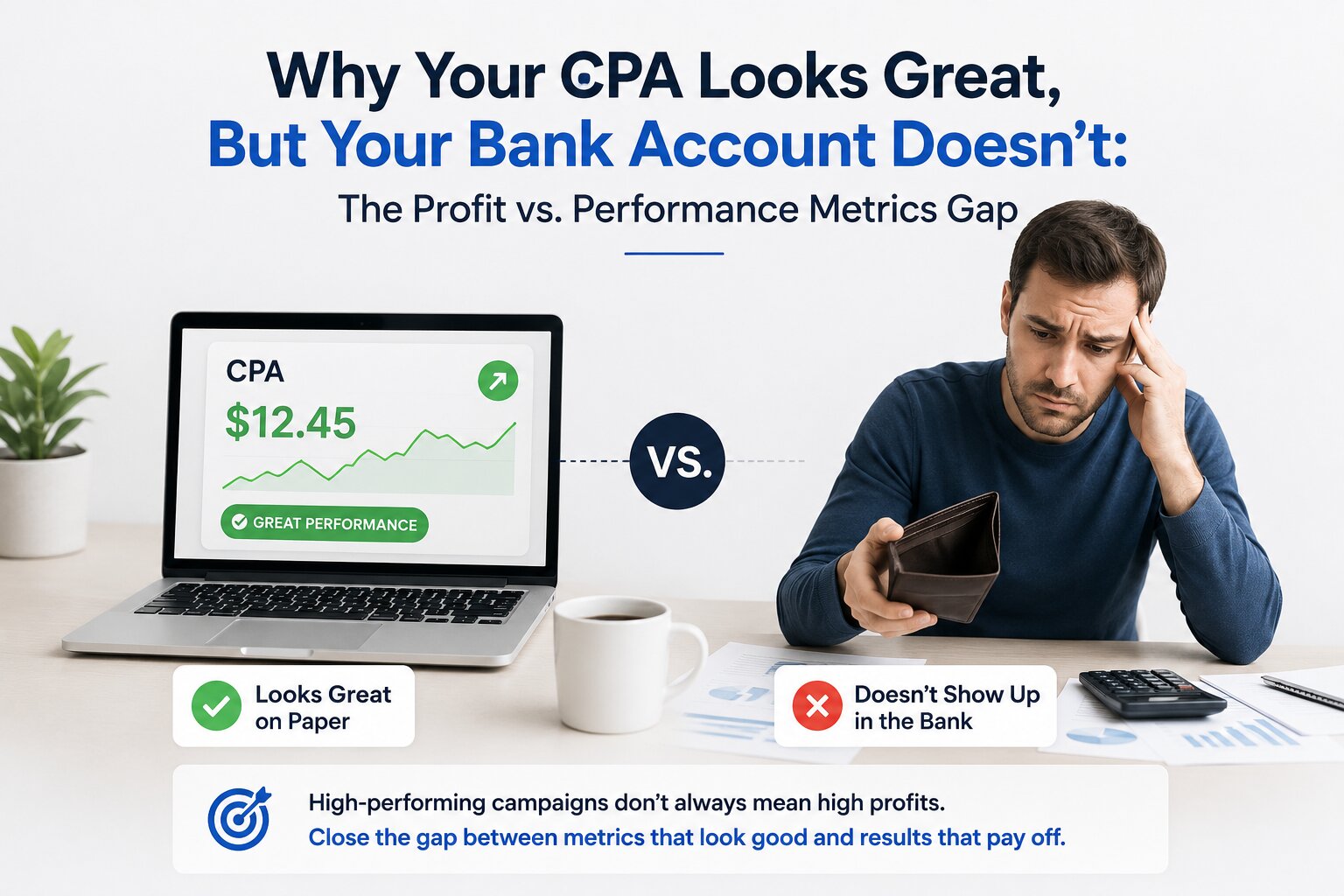
We’ve sat in more than a few review calls where a client points at the Ads Manager dashboard and says, “Look — CPA is down 20%, this is our best month ever.” Then we pull the P&L, and the best month ever was actually a loss. Nobody’s lying in that room. The dashboard is telling the truth. It’s just not answering the question that matters.
Tags
The Metric You’re Watching Isn’t the Metric That Pays Your Bills
CPA (Cost Per Acquisition) and ROAS (Return on Ad Spend) measure advertising efficiency—how cheaply you turned a dollar into a lead or a sale. Neither metric accounts for your profit margins, refund rate, shipping costs, or fixed overhead.
A campaign can achieve a 4x ROAS and still lose money if:
- Your product margin is under 25%, while your ROAS target was calculated for a business with a 50% margin.
- Discount codes or free shipping reduce your actual revenue, even though the ad platform reports the full sale value.
- Your refund or return rate is 15% or higher, but those refunds are never deducted from the reported revenue.
- Your blended CAC (organic + paid) appears healthy, while your paid-only CAC is too high to be profitable.
This is why two businesses can report identical CPAs, yet one is thriving while the other is quietly losing money.
The Three Numbers Nobody Puts on the Dashboard
Before trusting any CPA or ROAS metric, we ask clients for three numbers that most advertising dashboards never show:
- True Contribution Margin Per Sale: Revenue minus product cost, payment processing fees, shipping, and packaging—not gross revenue.
- Break-even CAC: The maximum amount you can spend to acquire a customer while remaining profitable on the first purchase—not an optimistic lifetime value estimate.
- Post-Refund, Post-Return Revenue: The actual amount deposited into your bank account after refunds and returns.
Compare your "great CPA" against these three numbers, and the picture often changes dramatically.
Where This Goes Wrong Most Often
- E-commerce Brands: Heavy discounts may improve ROAS while reducing actual profit.
- Lead Generation Businesses: Cheap leads don't always become paying customers, making CPA look better than it really is.
- Subscription Businesses: A low CAC in the first month means little if customers cancel after one or two months.
What We Actually Track Instead
We don't ignore CPA and ROAS—they're still useful indicators of campaign efficiency. However, every performance review also includes:
- Profit per acquisition, recalculated monthly as margins change.
- A break-even CAC target agreed upon before launching the campaign.
- A quarterly reconciliation against actual bank deposits rather than platform-attributed revenue.
The Uncomfortable Truth
Advertising platforms are designed to optimize metrics that make campaigns appear successful. That's simply how they work. Metrics like revenue and ROAS help justify ad spend, but they don't necessarily reflect your business profitability.
A great CPA is a signal—not a verdict. The real verdict is found in your bank account.
Not sure which option makes the most financial sense for your business? Book a free strategy call and we'll review your numbers honestly—even if the conclusion is that you don't need an agency yet.